AI Fluency Teaching Design Tool
Your Teaching Context
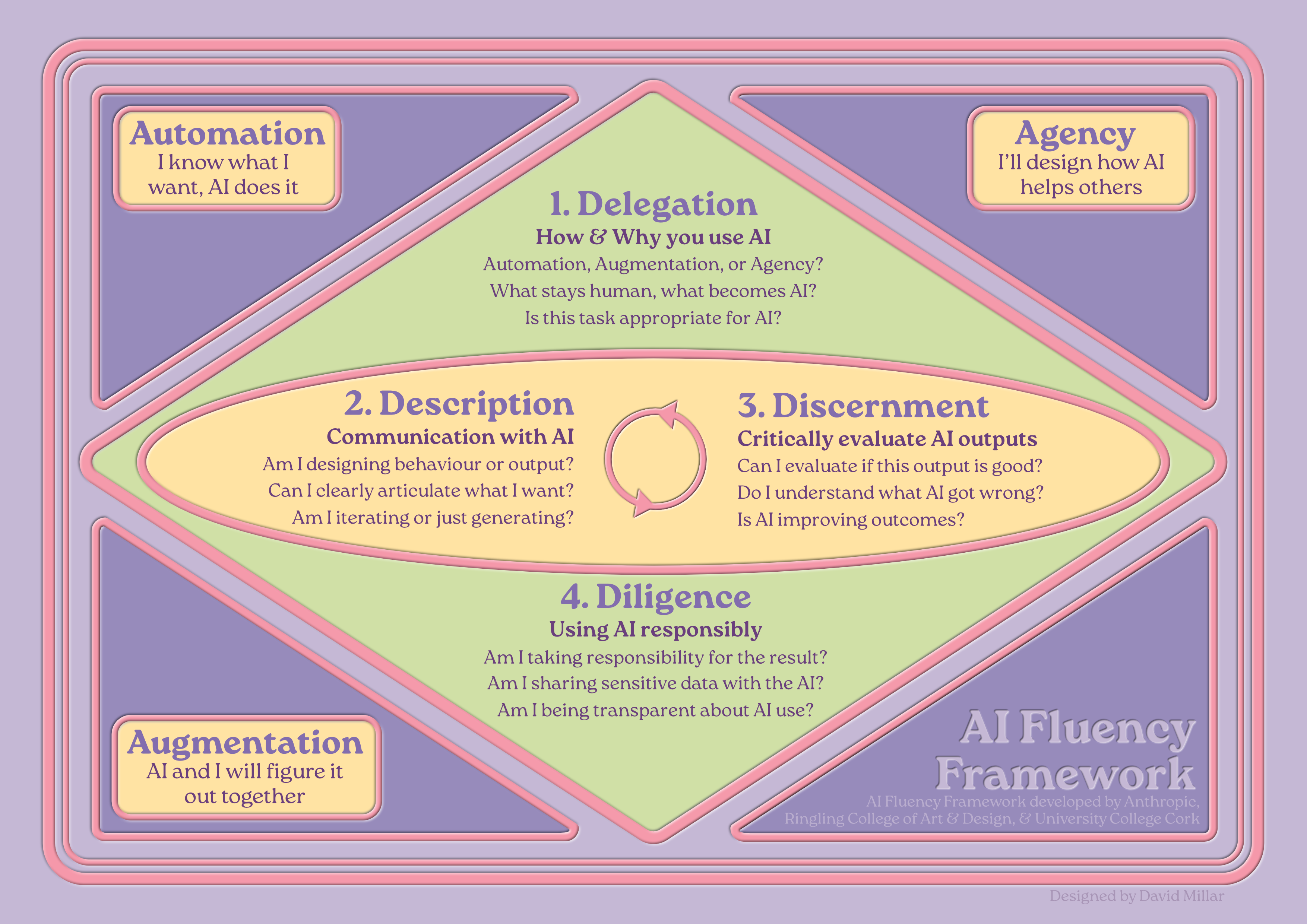
Before applying the AI Fluency Framework, establish the context for your teaching. This will help you make better decisions throughout the guide.
What do you teach and who are your students?
Consider: Subject area, level, cohort size, student characteristics, what brought them to this subject.
What are the three foundational questions for your teaching?
These lenses shape everything else you build. If you can't answer them clearly, your materials may inform students without actually reaching them.
Before Semester: Preparation
The decisions you make before semester begins shape how AI shows up in your teaching for months to come. Get the strategic foundation right (Delegation-Diligence), and you create space for excellent collaborative work (Description-Discernment).
What is your main preparation challenge?
For example: Creating lecture content, developing course materials, creating accessible materials, updating outdated resources, or another preparation task.
Delegation – Strategic Decision
Before touching any AI system, answer these questions.
Description & Discernment – Iterative Execution
Don't start with a generic prompt like "Create a lecture on [topic]". Build context over multiple exchanges. Plan your approach here.
Diligence – Final Check
Before using AI-assisted content with students, verify the following.
During Semester: Teaching
This is where preparation meets reality. Students arrive with different needs than anticipated. Energy dips around Week 6. Your carefully designed plans need adaptation.
What is your main teaching challenge?
For example: Facilitating active learning, supporting struggling students, providing feedback on student work, adapting when things aren't working, teaching practical application without industry experience.
Delegation – What needs support?
Description & Discernment – Working with AI
Diligence – Responsible Use
Critical principles for the teaching phase.
Providing Feedback on Student Work
AI can help you articulate feedback more clearly and efficiently – but you must never upload student work to AI systems. The judgement must remain yours. Read the work yourself, make rough notes, use AI to help articulate YOUR observations, then add your personal response.
What is your current feedback challenge?
Consider: Volume of marking, quality of feedback, timeliness, developmental value, maintaining personal connection.
Your ethical feedback process
The correct process: Read work yourself, make rough notes, use AI to help articulate YOUR observations (without sharing student work), then add your personal response.
After Semester: Reflection & Improvement
The semester ends. This is the moment when small investments in reflection create exponential improvements for next time.
What worked and what didn't?
Don't just summarise feedback – look for deeper themes about what enabled or blocked learning.
Planning improvements
You can't redesign everything. Focus on targeted improvements with genuine impact.
Building your practice over time
Each semester you learn. Capture that learning so you're not starting from scratch each time.
This AI Fluency Teaching Design Tool was designed by David Calum Millar using the AI Fluency Framework (Dakan, Feller & Anthropic, 2025) collaboratively with a custom agent called Morna, running on Claude (Anthropic), who is trained on the Creative Compass & Learning Design Compass frameworks by David Calum Millar, then developed using Claude Code. The final design, all editorial decisions, and responsibility for the tool’s content rest with the author.